Suggested Reading Five: January 21, 2026

Hi everyone, here are our five suggested reads of the week!

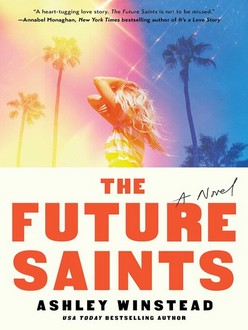
Future Saints by Ashley Winstead 

Winstead (In My Dreams I Hold a Knife) focuses on the demise of a women-led rock band in her latest. Told through the perspective of the bandmates, manager, and fans, this emotionally charged novel opens as the Future Saints perform at a nearly empty venue. The members of the Future Saints are on the cusp of giving up on everything–the music, their fans, and themselves–when lead singer Hannah closes the show with a new song that sets the internet on fire with its grief and honesty. The Future Saints are rocketed to a level of popularity that flummoxes the bandmembers as well as their new manager, Theo. As poor choices are made, captured for social media, and regurgitated within the band itself, they begin writing new music that captures their changed situation as well as their sadness at the death of their former manager, Ginny, who was also Hannah’s sister. Hannah ultimately confronts her grief in a dramatic way, bringing the story full circle and allowing catharsis. The novel’s satisfying epilogue places each character in the future where they need to be. VERDICT Fans of Stephanie Clifford’s The Farewell Tour will enjoy. – Library Journal Review  

– 

George Falls Through Time: A Novel by Ryan Collett 
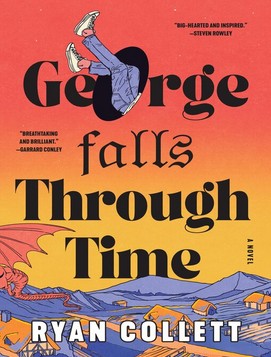
George’s life in present-day London keeps hitting new lows. He already lost his job and boyfriend, he’s about to lose his flat, and now, having taken a dog-walking gig, he has lost two of the six dogs that he was walking in the park. While a panicked George searches for the missing dogs, he observes the London he knows falling away. Somehow, he has traveled through time, and the only thing he can find out is that he’s in the 28th year of a King Edward’s reign (1300 CE). Time-travelling is brutally hard when you’re going backward: the language is foreign to George, and dragons, apparently, are known to exist in this world, which he can’t quite believe. He is thrown into prison, eventually escaping with the help of a man named Simon. Then George is brought before the king, who presents him with a plastic Coca-Cola bottle and demands an explanation. VERDICT Collett’s (The Disassembly of Doreen Durand) time-travel novel is a marvelously lovely queer retelling of the story of St. George and the dragon. Readers who loved Kaliane Bradley’s The Ministry of Time will enjoy this too. – Library Journal Review  

– 

Greatest Sentence Ever Written by Walter Isaacson 
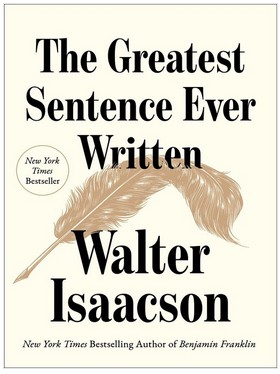
Thirty-five words. That’s the length of the second sentence of the Declaration of Independence, the one that begins with “We hold these truths to be self-evident” and ends with “Life, Liberty, and the Pursuit of Happiness.” In between, there is talk of equality and sacrosanct rights. It’s a lot to pack into a single sentence, but award-winning biographer Isaacson cogently honors the wisdom it took to create it. Its authors–Thomas Jefferson, Benjamin Franklin, and John Adams–struggled over concerns such as, who, precisely, should be included in “We” and whether “inalienable”” would be a better choice than “unalienable.” Glimpses into such behind-the-scenes polishing of the most important of our country’s foundational documents would be fascinating in and of itself, but as the Declaration’s 250th anniversary draws near, Isaacson’s granular analysis serves as a more potent lesson. Our nascent nation was freeing itself from Britain’s tyrannical rule, the facts of which are specifically enumerated in the body of the Declaration. Re-reading these grievances through the lens of today’s politically fraught atmosphere is a chilling but necessary exercise. In Isaacson’s expert hands, those 35 words, and the ones that come after them, gain a new level of clarity and relevance, and inspire deepened appreciation. – Booklist Review  

– 

The Infamous Gilberts: A Novel by Angela Tomaski  
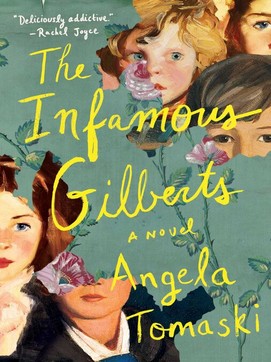
DEBUT Margaret Gilbert has long lived with her three daughters and two sons in Thornwalk, a once-stately English manor, until, in 2002, the keys to the manor are about to be handed over to a new owner who plans to transform the estate into a luxury hotel. But first, Maximus, who lives in a cottage on the property, walks readers through a more than 60-year history of the Gilbert family and their home. Tomaski’s sad, sometimes funny debut novel thrives on its personalities. There’s Hugo, the eldest Gilbert son, who plans to take over the family’s failing business after their father dies; Jeremy, the wanderer who disappears for long stretches at a time; and the three Gilbert daughters dreaming of love, whose poor choices as they try to marry into wealth cloud and complicate the family’s fate. Tomaski offers strong characterization as each Gilbert reveals the weaknesses and gullibility that will ultimately contribute to the family’s downfall as they struggle with the implications of marrying for money versus clinging to the hope of regaining lost love.

VERDICT Readers of Tomaski’s immersive multigenerational saga will be pulled into the lives of the Gilbert family. Recommended for fans of big English novels about people who cannot help themselves. -Library Journal Review 

– 

No One Would Do What the Lamberts Have Done: A Novel by Sophie Hannah
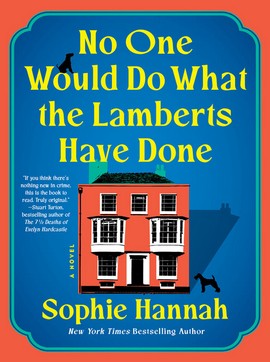
 

The twistiest murder mystery you are ever likely to read? A story about a family that does the unthinkable? 

Both? Or something else altogether? 

You think it will never happen to you. 

The doorbell. The policeman. The words that turn your world inside out: I’m afraid there’s been an incident… 

For Sally Lambert, those words mean only one thing—danger. Not just for her family, but for Champ, their loyal and beloved dog. A single accusation, a neighbor’s grudge, and suddenly the Lamberts are trapped in a nightmare with no escape. 

Unless they make one. 

Most people would never run. Most people would never leave behind everything they know to protect an animal who can’t defend himself. But for Sally, Champ is more than a dog—he’s one of her children. And most people aren’t the Lamberts.  

No one has ever done this before. No one has ever gone this far. But the Lamberts have never been quite like any other family… 

New York Times bestselling author Sophie Hannah spins an unexpected tale of suspense in No One Would Do What the Lamberts Have Done, an unsettling reflection on how far we’ll go for those we love. 

Happy reading!

Linda Reimer, SSCL

Weekly Suggested Reading Five postings are usually published on Wednesdays, unless Monday is a holiday and then they are published later in the week.

Note: Book summaries are from the respective publishers unless otherwise specified.

Information on the four library catalogs

The Digital Catalog aka Libby: https://stls.overdrive.com/

The Digital Catalog, is an online catalog containing eBooks, eAudiobooks, and digital magazines. You can use your library card and checkout content on a PC; you can also use the companion app, Libby, to access titles on your mobile devices; so you can enjoy eBooks and eAudiobooks on the go!

All card holders of all Southern Tier Library System member libraries can check out items from the Digital Catalog.

Hoopla Catalog: https://www.hoopladigital.com/

The Hoopla Catalog features on demand checkouts of eBooks, eAudiobooks, comic books, albums, movies and TV shows. Patron check out limit is 10 items per month.

Hoopla is a Southeast Steuben County Library service available to all Southeast Steuben County Library card holders.

The Hoopla companion app, also called Hoopla is available for mobile devices, smart TVs & media streaming players.

Kanopy Catalog: https://www.kanopy.com/en

The Kanopy Catalog features thousands of streaming videos available on demand.

The Kanopy Catalog is available for all Southern Tier Library System member library card holders, including all Southeast Steuben County Library card holders!

You can access the Kanopy Catalog through a web browser, or download the app to your phone, tablet or media streaming player (i.e. Roku, Google or Fire TV).

StarCat: The catalog of physical/traditional library materials: https://starcat.stls.org

Card holders of all Southern Tier Library System member libraries can access StarCat to search for and request materials available at libraries through out the Southern Tier Library System.

Have questions about how to access Internet based content (i.e. eBooks, eAudios)? Feel free to drop by the Reference Desk or call the library and we will assist you! The library’s telephone number is: 607-936-3713.

Tech & Book Talk is a Southeast Steuben County Library blog.

Did You Know…Victoria!

Hi everyone, here is our Did You Know… posting for May 2018!

Did you know…

Victoria!

So you’ve enjoyed the first two seasons of the PBS series Victoria, which chronicles the early life and reign of Queen Victoria and her dashing Prince Consort, Prince Albert of Saxe-Coburg and Gotha.

But did you know…

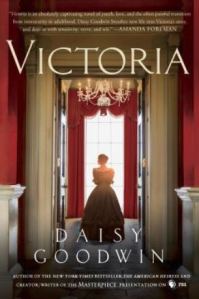
The TV series is based upon a book, Victoria: A Novel, written by Daisy Goodwin?

It is!

Daisy Goodwin began doing research for the novel while she was a student at Cambridge University. Goodwin read Victoria’s personal diaries to gain a greater understanding of what life was like for the teenage Princess Victoria, who became queen just a month after her eighteenth birthday.

Interestingly, the novel Victoria actually ends at the time the two cousins, Queen Victoria and Prince Albert, became engaged.

So the Goodwin book really is a bildungsroman!

And I love that word, bildungsroman!

Although the first time I read it, in a review of Harry Potter and the Deathly Hollows, I had to look it up in the dictionary!

But that is cool as learning is a wonderful thing!

The Concise Oxford English Dictionary defines bildungsroman as meaning “a novel dealing with a person’s formative years” , so the term does indeed apply to the story of the young Queen Victoria we see in seasons 1 & 2 of the PBS series.

And having now shown my library geekiness – I’ll get back to the subject at hand – the fact that the Goodwin novel Victoria, which admittedly is only her first book on Queen Victoria*, covers a relatively short period of Queen Victoria’s life beginning just as she becomes queen in 1837 and ending just before her marriage to Prince Albert in 1840. The TV series has already gone past that point in history. And the real life story of Queen Victoria went on for another 61 years! In fact, Queen Victoria held the record for the longest reigning monarch in British history for more than one hundred years until the record was broken by Queen Elizabeth in 2015.

Did you know…

That there are several book available that will allow you, like Daisy Goodwin, to read entries from Queen Victoria’s private diaries?

There are!

The library owns two of them —

Life at the Court of Queen Victoria: 1861-1901 written by Queen Victoria and edited by Barry St-John Nevill:

And

Dearest Mama: Private Correspondence of Queen Victoria and the Crown Princess of Prussia, 1861-64:

Did you know…

That the scientist Ada Lovelace, seen in Season 2, Episode 2 of the Victoria TV series, is considered to be the first computer programmer?

She is!

Disclaimer! I am not a math person! I’d rather write essays all day long then work on advanced math problems! So to properly illustrate Ada Lovelace’s importance, I’m going to quote from her New York Times obituary* the information that relays just why, today, she is considered the first computer programmer:

“A century before the dawn of the computer age, Ada Lovelace imagined the modern-day, general-purpose computer. It could be programmed to follow instructions, she wrote in 1843. It could not just calculate but also create, as it “weaves algebraic patterns just as the Jacquard loom weaves flowers and leaves.”

The computer she was writing about, the British inventor Charles Babbage’s Analytical Engine, was never built. But her writings about computing have earned Lovelace — who died of uterine cancer in 1852 at 36 — recognition as the first computer programmer.

The program she wrote for the Analytical Engine was to calculate the seventh Bernoulli number. (Bernoulli numbers, named after the Swiss mathematician Jacob Bernoulli, are used in many different areas of mathematics.) But her deeper influence was to see the potential of computing. The machines could go beyond calculating numbers, she said, to understand symbols and be used to create music or art.

“This insight would become the core concept of the digital age,” Walter Isaacson wrote in his book “The Innovators.” “Any piece of content, data or information — music, text, pictures, numbers, symbols, sounds, video — could be expressed in digital form and manipulated by machines.” (Claire Cain Miller, the New York Times, Online)

So you see, all of us who use technology, from casual cell phone users to tech geeks who eagerly await the next new and exciting personal technology news, should celebrate the work of Ada Lovelace, as without her work we might not have the technology we have today!

Did you know…

That author Walter Isaacson makes prominent mention of Ada Lovelace and her contributions to computer science in his book The Innovators: How a Group of Hackers, Geniuses, and Geeks Created the Digital Revolution?

He does!

Not surprisingly, considering how patriarchal an era the 19th Century was, female scientists and inventors of that era have largely been forgotten by those writing the history books. Walter Isaacson does his bit to set the record straight in his book by highlighting the important work done by female scientists.

And as a fun little aside, Isaacson was inspired to research the work done by female scientists and innovators and emphasize that work in his book by, of all things, his daughter’s school work! It seems when Isaacson’s daughter, Betsy, was in college she spent a long time procrastinating and putting off writing her obligatory college essay, much to the chagrin of her parents. And when she finally completed the two-page essay her father asked her what subject she had chosen to write about and she replied “Ada Lovelace”, and noted that historically, women who have made contributions to the sciences have been forgotten. And Betsy planted a seed that eventually inspired Isaacson to emphasize the work done by female scientists and inventors as a major thread in his book.

If you haven’t read the Isaacson book it is fascinating and it discusses a number of scientists and inventors including: Ada Lovelace, Admiral and Computer Scientist Grace Hopper, Vannevar Bush head of the U.S. Office of Scientific Research and Development during World War II, Robert Noyce of Intel, Bill Gates & Paul Alan of Microsoft, Steve Jobs & Steve Wozniak of Apple, Larry Page of Google, Jimmy Wales of Wikipedia and many others.

And should you wish to read Walter Isaacson’s excellent book on technological innovators – click on the photo to request it!

Getting back to the subject of Queen Victoria…

Did you know…

That Prince Albert really did break through the ice while skating and that Queen Victoria really did save him, as seen in the last episode of the second season of Victoria?

He did and she did!

We all know that TV adaptations of books, based on historical fact, are fictionalized a bit when adapted for television or the big screen. So I wondered when I saw that scene if it happened in real life or if it was just created to give more pizzazz to the storyline so I looked it up!

And I discovered that Prince Albert was an enthusiastic ice skater, and that in early 1841 Queen Victoria had a new pair of skates made especially for him. Subsequently, the royal couple went for a walk in Buckingham Palace’s Kensington Gardens with only one Maid of Honour, the Hon Miss Murray, in tow. Prince Albert put on his new skates and was zipping across the ice when he fell through the ice and into the frigid water. Queen Victoria directed Miss Murray to take one of her hands while she reached for Prince Albert with her other hand, and together they pulled Prince Albert out of the water!

And if I didn’t know that story was true I’d say it couldn’t possibly be – but it really did happen!

And here is a description of the accident given by Prince Albert himself in a letter he sent to his stepmother: “I managed, in skating, three days ago, to break through the ice in Buckingham Palace Gardens. I was making my way to Victoria, who was standing on the bank with one of her ladies, and when within some few yards of the bank I fell plump into the water, and had to swim for two or three minutes in order to get out.

“Victoria was the only person who had the presence of mind to lend me assistance, her lady being more occupied in screaming for help. The shock from the cold was extremely painful, and I cannot thank Heaven enough, that I escaped with nothing more than a severe cold.”

So the skating accident may sound like fiction but it is fact!

And for our final did you know of the month…

Did you know…

That Queen Victoria and Prince Albert had nine children?

They did!

And here is a list of Queen Victoria & Prince Albert’s children:

Vicky (Princess Victoria, later German Empress, 1840-1901):

Bertie (Albert Edward Prince of Wales, later King Edward VII, 1841-1910)

Alice (Princess Alice, later Grand Duchess of Hesse, 1843-1878)
Note: Princess Alice’s great-grandson is the current Prince Consort, Prince Philip, Duke of Edinburgh.

Alfred (Prince Alfred, Duke of Edinburgh, later Duke of Saxe-Coburg and Gotha 1844-1900)

Helena (Princess Helena, later Princess Christian of Schleswig-Holstein, 1846-1923)

Louise (Princess Louise, later Duchess of Argyll, 1848-1939)

Arthur (Prince Arthur, Duke of Connaught and Strathearn, 1850-1942)

Leopold (Prince Leopold, Duke of Albany 1853-1884)

Beatrice (Princess Beatrice, later Princess Henry of Battenberg, 1857-1944)

Victoria Books & DVDs To Enjoy:

Books:

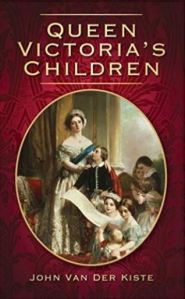
Queen Victoria’s Children by John Van der Kiste

Victoria: A Novel by Daisy Goodwin

Victoria and Albert: A Royal Love Affair by Goodwin and Sarah Sheridan:

Note: This is the companion book to the second season of the Victoria TV series!

Victoria’s Daughters by Jerrold Packard:

DVDs

Edward The King (TV Mini Series from 1975):

And yes, the series is about Queen Victoria’s son Bertie, known to history as King Edward VII. However, as Queen Victoria lived a long time and King Edward survived her by less than ten years — there is a quite a bit of Victoria seen in this dramatized series.

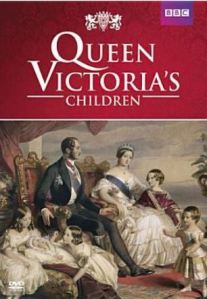
Queen Victoria’s Children:

Queen Victoria’s Empire:

Victoria & Abdul (2017):

Victoria: the Complete First Season:

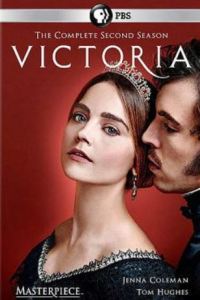
Victoria: The Complete Second Season:

The Young Victoria (2008) (A stand alone movie not related to the current PBS TV series):

* Season 2 of the PBS series Victoria is based upon the book Victoria and Albert: A Royal Love Affair which was co-authored by Daisy Goodwin and Sarah Sheridan

*Overlooked: Ada Lovelace – Overlooked is a new obituary series the New York has created that highlights the lives of women whose contributions to society were previously overlooked due to their gender.

Have a great day!
Linda, SSCL

References (Because libraries love to cite their sources!)

Bilton, Nick. The Women Tech Forgot ‘The Innovators’ by Walter Isaacson: How Women Shaped Technology. 14 October 2014. The New York Times. Accessed April 30, 2018. https://www.nytimes.com/2014/10/02/fashion/the-innovators-by-walter-isaacson-how-women-shaped-technology.html

Dearest Mama: Letters Between Queen Victoria and the Crown Princess of Prussia 1861-1864. New York, Holt, Rinehart and Winston. 1969.

Gilbert, Deborah. Daisy Goodwin on Writing and Creating Victoria on MASTERPIECE. 12 January, 2018.Thirteen (PBS). Online. Accessed April 30, 2018.
https://www.thirteen.org/blog-post/daisy-goodwin-on-writing-and-creating-victoria-on-masterpiece/

Isaacson, Walter, The Innovators: How a Group of Hackers, Geniuses, and Geeks Created the Digital Revolution. New York. Simon & Schuster. 2014.

Miller, Claire Cain. Overlooked: Ada Lovelace: A Gifted mathematician who is now recognized as the first computer programmer. The New York Times. Online. Accessed April 30, 2018.
https://www.nytimes.com/interactive/2018/obituaries/overlooked-ada-lovelace.html

Life at the Court of Queen Victoria: 1861-1901. Edited by Barry St-John Nevill, Illustration from the collection of Lord Edward Pelham-Clinton, Master of the Household. Exeter. Webb & Bower, 1984.

Goodwin, Daisy. Victoria. St. Martin’s Press. New York. 2016.

Prince Albert. The Home of the Royal Family. Online. Accessed April 30, 2018.
https://www.royal.uk/prince-albert

The true story of Prince Albert’s ice-skating accident – and how Queen Victoria saved his life. Radio Times. Online. Accessed. April 30, 2018.
http://www.radiotimes.com/news/tv/2018-04-27/the-true-story-of-prince-alberts-ice-skating-accident-and-how-queen-victoria-saved-his-life/

Victoria (r. 1837-1901). The Home of the Royal Family. Online. Accessed April 30, 2018.
https://www.royal.uk/victoria-r-1837-1901

StarCat (The catalog of physical materials, i.e. books, DVDs, music CDs etc.):

OverDrive (The catalog of digital materials including eBooks, downloadable audio books and a handful of streaming videos):

Freegal Music Service (The streaming catalog of music available for free to library card holders):

RB Digital (Free magazines – on demand!):

And apps for OverDrive, Freegal & RB Digital can be found in your app store – so you can access digital library content on a laptop/desktop computer or on a mobile device.