Hi everyone, here are links to the list of New York Times Bestsellers.
New York Times Bestsellers can be requested through StarCat (for print books) & The Digital Catalog/Libby for eBooks and Downloadable Audiobooks. Select titles may also be checked out, on demand, through the Hoopla Catalog/app.
For more information on the three catalogs skip to the section below the bestselling titles*
–
New York Times Bestseller blog posts are usually published on Sundays; although the new New York Times Bestseller Lists come out, and are accessible for free through the NYT website, on Thursdays.
For this week; due to holidays closings and vacations, I’m going to provide the direct links to the New York Times Bestseller lists so you can access the bestseller lists and see what new books are popular anytime during the rest of the holiday season.
Our regular New York Times Bestsellers blog posts will resume next Sunday, January 13, 2024.
–
The New York Times Hardcover Fiction Bestseller Bestsellers
Card holders of all Southern Tier Library System member libraries can access
StarCat to search for and request materials available at libraries throughout the Southern Tier Library System.
–
Also of Note: If a New York Times Bestseller isn’t yet available in any of the three catalogs, you can contact the library and request to be notified when it becomes available.
Southeast Steuben County Library Telephone Number: 607-936-3713.
–
Tech Talk is a Southeast Steuben County Library blog.
Hi everyone, here are our recommended reads for the week!
*More information on the three catalogs and available formats is found at the end of the list of recommended reads*
–
Weekly Suggested Reading postings are published on Wednesday.
And the next Suggested Reading posting will be published on Wednesday, January 10, 2024.
–
Here is our baker’s dozen of twenty two “some of the best of 2023” recommended non-fiction reads!
And next Wednesday, we’ll resume our usual recommended reads postings.
–
1898: Visual Culture and U.S. Imperialism in the Caribbean and the Pacific by Taína Caragol & Kate Clarke Lemay
A revealing look at U.S. imperialism through the lens of visual culture and portraiture
In 1898, the United States seized territories overseas, ushering in an era of expansion that was at odds with the nation’s founding promise of freedom and democracy for all. This book draws on portraiture and visual culture to provide fresh perspectives on this crucial yet underappreciated period in history.
Taína Caragol and Kate Clarke Lemay tell the story of 1898 by bringing together portraits of U.S. figures who favored overseas expansion, such as William McKinley and Theodore Roosevelt, with those of leading figures who resisted colonization, including Eugenio María de Hostos of Puerto Rico; José Martí of Cuba; Felipe Agoncillo of the Philippines; Padre Jose Bernardo Palomo of Guam; and Queen Lili‘uokalani of Hawai‘i. Throughout the book, Caragol and Lemay also look at landscapes, naval scenes, and ephemera. They consider works of art by important period artists Winslow Homer and Armando Menocal as well as contemporary artists such as Maia Cruz Palileo, Stephanie Syjuco, and Miguel Luciano. Paul A. Kramer’s essay addresses the role of the Smithsonian Institution in supporting imperialism, and texts by Jorge Duany, Theodore S. Gonzalves, Kristin L. Hoganson, Healoha Johnston, and Neil Weare offer critical perspectives by experts with close personal or scholarly relations to the island regions.
Beautifully illustrated, 1898: Visual Culture and U.S. Imperialism in the Caribbean and the Pacific challenges us to reconsider the Spanish-American War, the Philippine-American War, and the annexation of Hawai‘i while shedding needed light on the lasting impacts of U.S. imperialism.
Published in association with the Smithsonian’s National Portrait Gallery, Washington, DC
–
The Art Thief by Michael Finkel
In this masterful true crime account, Finkel (The Stranger in the Woods) traces the fascinating exploits of Stéphane Breitwieser, a French art thief who stole more than 200 artworks from across Europe between 1995 and 2001, turning his mother’s attic into a glittering trove of oil paintings, silver vessels, and antique weaponry. Mining extensive interviews with Breitwieser himself, and several with those who detected and prosecuted him, Finkel meticulously restages the crimes, describing the castles and museums that attracted Breitwieser and Anne-Catherine Kleinklaus, his accomplice and romantic partner; the luminous oils and sculptures that caught Breitwieser’s eye; and the swift, methodical actions he took to liberate his prizes. According to Breitwieser, his sole motive was aesthetic: to possess great beauty, to “gorge on it.” Drawing on art theory and Breitwieser’s psychology reports, Finkel speculates on his subject’s addiction to beauty and on Anne-Catherine’s acquiescence to the crimes. The account is at its best when it revels in the audacity of the escapades, including feats of misdirection in broad daylight, and the slow, inexorable pace of the law. It’s a riveting ride. – Starred Publishers Weekly Review
–
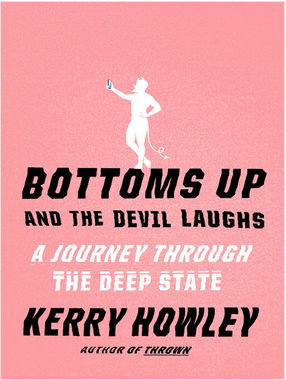
Bottoms Up and the Devil Laughs: A Journey Through the Deep State by Kerry Howley
In this wide-ranging, often chilling survey, Howley meditates on the ways in which data collected by U.S. government agencies can be used to invade and destroy the lives of citizens. At the heart of her expos is Reality Winner (“Her real name, let’s move past it now”). Winner served as a linguist and surveillance expert with a high security clearance in the U.S. Air Force, and then as a consultant in a firm from which she leaked a document about possible Russian interference in the U.S. elections–a leak that earned her the longest sentence ever handed down for an Espionage Act conviction. In a sometimes rambling but always provocative narrative, which also covers “American Taliban” member John Walker Lindh and others accused of espionage, Howley makes a convincing argument that Winner was convicted less for the leak than for misleading evidence from old social media posts and personal texts, written playfully but interpreted as serious, and suggests that we all might be subject to danger from the same sort of posts, preserved without our knowledge in government databases. – Booklist Review
–
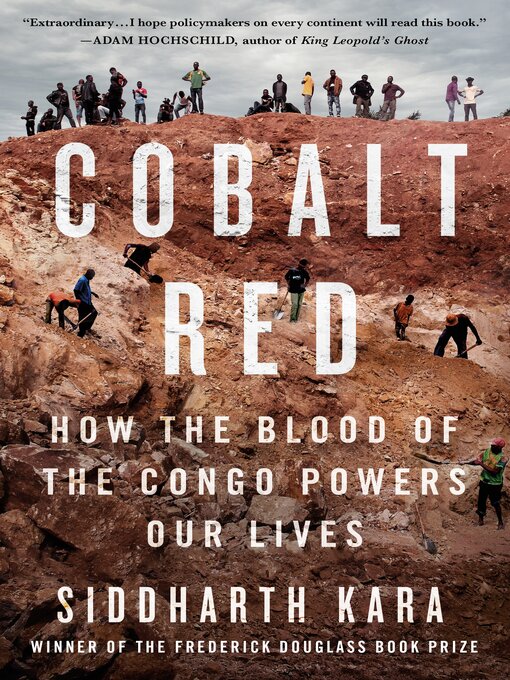
Cobalt Red: How the Blood of the Congo Powers Our Lives by Siddharth Kara
In this tour-de-force exposé, Kara (Modern Slavery), a professor of human trafficking and modern slavery at Nottingham University, uncovers the abuse and suffering powering the digital revolution. Explaining that cobalt is “an essential component to almost every lithium-ion rechargeable battery made today,” and that the Katagana region in the Democratic Republic of Congo “holds more reserves of cobalt than the rest of the planet combined,” Kara describes young children and pregnant women mining the metal by hand for a dollar a day. Predatory middlemen then sell the cobalt to foreign- and state-owned mining operations, who supply the materials for Apple, Samsung, and Tesla products. The details are harrowing: young men and boys are crushed in tunnel collapses, women and girls work in radioactive wastewater, villages are razed, and 14-year-olds are shot for seeking better prices. While corrupt government officials siphon the profits from the cobalt industry, ordinary Congolese “eke out a base existence characterized by extreme poverty and immense suffering.” “Here,” says the widow of one artisanal miner, “it is better not to be born.” Throughout, Kara’s empathetic profiles and dogged reporting on the murkiness of the cobalt supply chain are buttressed by incisive history lessons on the 19th-century plunder of the Congo for ivory and rubber, the CIA-orchestrated overthrow of democratically elected president Patrice Lumumba in 1960, and more. Readers will be outraged and empowered to call for change. – Starred Publishers Weekly Review
–
The Coming Wave: Technology, Power, and the Twenty-first Century’s Greatest Dilemma Kindle Edition by Mustafa Suleyman
Amid the flood of optimism about artificial intelligence, the significant dangers must be understood and assessed. Suleyman might seem like a strange person to write a book about the dangers of AI. He is the CEO and co-founder of Inflection AI, and, before that, he co-founded DeepMind (now owned by Alphabet), a company working at the leading edge of AI research. As the author shows, however, it is precisely because he is an expert that he knows enough to be fearful. He believes that within a few years, AI systems will break into the broad public market, placing enormous computing power in the hands of anyone with a few thousand dollars and a bit of expertise. Suleyman recognizes that this could bring remarkable benefits, but he argues that the negatives are even greater. One frightening possibility is a disgruntled individual using off-the-shelf AI to manufacture a deadly, unstoppable virus. Other scenarios range from disrupting financial markets to creating floods of disinformation. Suleyman accepts that the AI genie is too far out of the bottle to be put back; the questions are now about containment and regulation. There is a model in the framework established by the biomedical sector to set guidelines and moral limits on what genetic experiments could take place. The author also suggests looking at “choke points,” including the manufacturers of advanced chips and the companies that manage the cloud. The key step, however, would be the development of a culture of caution in the AI community. As Suleyman admits, any of these proposals would be extremely difficult to implement. Nonetheless, he states his case with clarity and authority, and the result is a worrying, provocative book. “Containment is not, on the face of it, possible,” he concludes. “And yet for all our sakes, containment must be possible.” An informative yet disturbing study and a clear warning from someone whose voice cannot be ignore. Starred Kirkus Review
–
Crossings: How Road Ecology Is Shaping the Future of Our Planet by Ben Goldfarb
In this captivating outing, science writer Goldfarb (Eager) explores the negative impact roads have on wildlife. Discussing the danger vehicle collisions pose to animals, he notes that 10,000 garter snakes were fatally hit in one season in Manitoba and that deer need intervals of approximately a minute or longer between passing cars to safely cross. Other harms are less obvious; the difficulty of traversing roadways leads to genetically inbred clusters (“A flightless European beetle disperses so feebly that biologists once found a genetically distinct population encircled by a highway exit loop”), and noise can disrupt ecological checks and balances (chaffinches in Portugal’s oak woodlands avoid loud streets, “allowing unchecked insects to kill roadside trees”). Profiles of individuals working on mitigation strategies are as enlightening as they are encouraging. Among them, Goldfarb highlights biologist Tony Clevenger’s research confirming the effectiveness of wildlife overpasses for enabling grizzly bear populations in Alberta’s Banff National Park to intermingle and ecologist Sarah Perkins’s efforts with Project Splatter to learn more about animal movement patterns by soliciting civilians to report roadkill. Humor leavens the frequently grim subject matter, as when Goldfarb notes that a plan to reduce Dall sheep’s anxiety around vehicles in Denali National Park “runs 428 turgid pages and reliably cures insomnia.” This one’s a winner. Photos. – Starred Publishers Weekly Review
–
Elon Musk by Walter Isaacson
Reckless ambition, ruthless drive, and psychic demons swaddle the soul of a wounded child in this sweeping biography of the celebrated industrialist. Biographer Isaacson (Steve Jobs) paints Musk as a tech visionary who wants to colonize Mars with his rocket company SpaceX, decarbonize transportation with his Tesla electric cars, and guarantee freedom of speech on the internet (as long as said speech doesn’t personally offend him) by buying Twitter. He portrays Musk as an innovator who embraced risk-taking both for better (he replaced a standard, $3-million cooling system on his rockets with a commercial home air-conditioning system costing $6,000) and worse (his decision to leave out a part designed to keep fuel from sloshing caused a rocket to explode in mid-flight). Musk is a callous, volatile boss, raging at underlings and forcing them to work round-the-clock. (“You have ninety days to do it. If you can’t make that work, your resignation is accepted” went a typical pep talk.) And he’s a monumental head case—as a boy, a loner abused by his father and beaten bloody by bullies; as a man, a manic-depressive drawn to chaos in business, romance, and any number of ill-considered Tweets. Isaacson shadowed Musk for two years and conjures a richly detailed, evocative portrait that nails his impulsive personality. The result is an illuminating study that demonstrates why Musk is the most captivating of today’s plutocrats. – Starred Kirkus Review
–
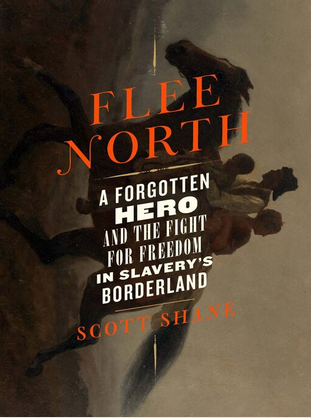
Flee North: A Forgotten Hero and the Fight for Freedom in Slavery’s Borderland by Scott Shane
Pulitzer Prize–winning reporter Shane (Objective Troy) has deftly woven this historical account about Thomas Smallwood, born in enslavement but who bought his freedom and became a contributor in the success of the Underground Railroad. Smallwood, who ran a small shoemaking establishment (circa 1840s) within sight of the White House, helped freedom seekers in Baltimore and Washington, DC. He recruited Charles T. Torrey, a young, white activist/minister/journalist, to help him. Torrey wrote satirical newspaper columns that documented their efforts and mocked enslavers, traders, and people who thought it their right to keep people enslaved. Smallwood and Torrey’s partnership forms the basis of this book and serves as a wonderful introduction for readers unaware of all that went on before the Civil War. VERDICT An exceptionally well-written book that takes readers into the life and political development of Smallwood. General readers and all types of libraries will need to add this book to their to-be-read lists and collections. – Starred Library Journal Review
–
Freedom from Fear: An Incomplete History of Liberalism by Alan S. Kahan
A provocative new history of liberalism that also provides a road map for today’s liberals
Freedom from Fear offers a striking new account of the dominant political and social theory of our time: liberalism. In a pathbreaking reframing of the historical debate, Alan Kahan charts the development of Western liberalism from the late eighteenth century to the present. Examining key liberal thinkers and issues, Kahan shows how liberalism is both a response to fear and a source of hope: the search for a world in which no one need be afraid.
Freedom from Fear reveals how liberal arguments typically rely on three pillars: freedom, markets, and morals. But when liberals ignore one or more of these pillars, their arguments generally fail to persuade. Extending from Adam Smith and Montesquieu to today’s battles between liberals and populists, the book examines the twists and turns of the “incomplete” or unfinished liberal tradition while demonstrating its fundamental continuity. It combines fresh accounts of familiar figures such as Tocqueville and Rawls with discussions of less-famous but pivotal thinkers such as A. V. Dicey and Jane Addams, and explores how liberals have dealt with crucial issues, from debates over male and female suffrage to colonialism and liberal anti-Catholicism.
By transforming our understanding of the history of liberal thought and practice, Freedom from Fear provides a new picture of the political creed today: the paths liberals need to follow, the questions they need to answer, and the dead ends they must avoid—if they are to win. – Publisher Description
–
Fire Weather: A True Story From A Hotter World by John Vaillant
A NEW YORK TIMES TOP TEN BOOK OF THE YEAR • FINALIST FOR THE NATIONAL BOOK AWARD IN NONFICTION • ONE OF TIME’S 100 MUST-READ BOOKS OF THE YEAR • A stunning account of a colossal wildfire that collided with a city, and a panoramic exploration of the rapidly changing relationship between fire and humankind from the award-winning, best-selling author of The Tiger and The Golden Spruce • Winner of the Baillie Gifford Prize for Non-Fiction
“Grips like a philosophical thriller, warns like a beacon, and shocks to the core.” —Robert Macfarlane, bestselling author of Underland
“Riveting, spellbinding, astounding on every page.” —David Wallace-Wells, #1 bestselling author of The Uninhabitable Earth
In May 2016, Fort McMurray, the hub of Canada’s oil industry and America’s biggest foreign supplier, was overrun by wildfire. The multi-billion-dollar disaster melted vehicles, turned entire neighborhoods into firebombs, and drove 88,000 people from their homes in a single afternoon. Through the lens of this apocalyptic conflagration—the wildfire equivalent of Hurricane Katrina—John Vaillant warns that this was not a unique event, but a shocking preview of what we must prepare for in a hotter, more flammable world.
Fire has been a partner in our evolution for hundreds of millennia, shaping culture, civilization, and, very likely, our brains. Fire has enabled us to cook our food, defend and heat our homes, and power the machines that drive our titanic economy. Yet this volatile energy source has always threatened to elude our control, and in our new age of intensifying climate change, we are seeing its destructive power unleashed in previously unimaginable ways.
With masterly prose and a cinematic eye, Vaillant takes us on a riveting journey through the intertwined histories of North America’s oil industry and the birth of climate science, to the unprecedented devastation wrought by modern forest fires, and into lives forever changed by these disasters. John Vaillant’s urgent work is a book for—and from—our new century of fire, which has only just begun. – Publisher Description
–
How to Know a Person: The Art of Seeing Others Deeply and Being Deeply Seen by David Brooks
In this chatty, charming volume, conservative NY Times commentator Brooks (The Road to Character, 2015) synthesizes the findings of psychologists and philosophers recent and past to make a case for the value of friendship and offer practical suggestions on how to connect more deeply with both old friends and new acquaintances. Acknowledging his own “certain aloofness,” he illustrates his points with personal anecdotes from his life (including a wrenching one about the death by suicide of a close friend and earnestly told experiences on discussion panels) and those of others (including novelist and theologian Frederick Buechner and former president George W. Bush). Seeking to confront the “epidemic of loneliness” in the United States, Brooks recommends “tenderness, receptivity, and active curiosity,” and suggests that we should all strive less to be heroes than to be “illuminators”–in other words, people who are “social, humble, understanding, and warm.” His advice may not be revolutionary, but it’s certainly down-to-earth and entertaining. – Booklist Review
–
King: A Life by Jonathan Eig
Award-winning biographer and journalist Eig (Ali: A Life) turns his lens on the Rev. Dr. Martin Luther King Jr. (1929-68). Mining a trove of materials–many only recently available–augmented with voluminous archival work and hundreds of interviews for personal insights, Eig advances the already appreciable quantity of first-rate biographies and intensive scholarship on King. He also recovers the man, foibles and all, from the too often hollowed-out, sainted symbol that competing ideologies have sanitized for national observance. His 45 engrossing chapters depict King from his enslaved family’s history in antebellum Georgia, his stern father’s high expectations, and his soothing mother’s calm warmth, through his April 1968 assassination in Memphis. The ambitious, anxious, contemplative, depressed, fun-loving, uncertain private King gets equal attention to the determined, eloquent, fearless public person in the spotlight. From his decrying state-sanctioned and vigilante violence to his stance against the U.S. war in Vietnam and his Poor People’s Campaign, Eig notes it all and paints a thorough picture of King.
VERDICT A must for readers interested in moving beyond cliched catchphrases to see a more complete and complex King, the context of his charisma, and the creation and content of his character. – Library Journal Review
–
Leg: The Story Of A Limb And The Boy Who Grew From It: A Memoir by Greg Marshall
A man born with cerebral palsy reflects on his life. Essayist Marshall recounts his childhood in 1990s Utah as the middle sibling of five “in a rowdy family where someone was always almost dying or OD-ing.” His father managed a small community newspaper group, and his mother wrote an inspirational column called “Silver Linings” while enduring debilitating cancer treatments and years of remissions and recurrences. Marshall walked with a perpetual limp, documented in his mother’s columns, and he underwent numerous therapies, surgeries, and recovery bouts in wheelchairs. In an effort to somehow shield their son from ridicule, however, his parents kept his cerebral palsy diagnosis a secret throughout his childhood, calling his chronic limp a nagging case of “tight tendons.” In a zesty, forthright series of humorous, heartfelt, and often wincingly oddball anecdotes, Marshall shares how his hypochondriacal family “leaned into” all of “life’s curveballs.” Brotherly boyhood shenanigans involving a back massager introduced him to masturbation, and at the same time, he nurtured a simmering fondness for other boys and struggled with HIV/AIDS education (“Did everyone know I was gay? Was this lesson for me? These other assholes weren’t going to get AIDS, but I was”). In the second half, Marshall chronicles his coming out as a disabled gay man, acknowledging life with CP, and navigating the nuances of first impressions, intimacy, and forgiveness for his parents. Marshall was 30 when he accidentally confirmed his CP diagnosis after uncovering one of his mother’s columns exposing “the Watergate tapes of my childhood, revealing both crime and cover-up.” The author, who confesses that “my cerebral palsy has made me see my life, and my leg, with renewed appreciation,” displays a natural storytelling ability, and he writes with a good dose of self-effacing humor, exposing the murky consequences of secrets, even when they’re kept with the best intentions. A sparkling portrait of personal discovery and a celebration of family, forgiveness, and thriving with a disability. – Kirkus Review
–
My Name Is Barbra by Barbra Streisand
Streisand’s long-anticipated debut memoir doesn’t disappoint. Utilizing her own journals, her mother’s scrapbooks, and interviews with colleagues and friends, the decorated singer and actor delivers a thoroughly enjoyable survey of her life and career that—even at nearly 1,000 pages—never overstays its welcome. Streisand begins with her teenage adventures fleeing her emotionally distant mother and stepfather’s Brooklyn apartment for Manhattan, where she and a friend went to see Broadway plays and where she eventually moved and got her first taste of showbiz success singing in nightclubs. From there, she dives deep into her key projects and famous relationships, writing of being booted off the Billboard top two by the Beatles (“Their sound was sensational, so I had no complaints”), developing stage fright during her star-making turn in the Broadway musical Funny Girl, and falling in love with leading men from Elliott Gould to James Brolin. The tone throughout is delightfully garrulous, often verging on conspiratorial: Streisand offers detailed descriptions of not only who she rubbed elbows with, but what everyone ate, what they wore, how the room was decorated, and what she really thought about it all (at one point, she returns a dress Phyllis Diller bought her so she can use the money to purchase fabric for a custom design). That combination of fastidiousness and looseness, mixed with Streisand’s natural humor, makes for a deliriously entertaining autobiography that gathers heft from the sheer breadth of its author’s experiences and achievements. This is a gift. – Publishers Weekly Review
–
Our Migrant Souls: A Meditation on Race and the Meanings and Myths of “Latino” by Héctor Tobar
“”What do we pass on to our children when we call ourselves Latino?”” This question of legacy is central to Tobar’s (The Last Great Road Bum, 2020) eye-opening investigation into Latin American heritages, whether identified as Latinx, Latin@, Latine, or otherwise. As the son of Guatemalan immigrants, the question is personal for Tobar, who treats this inquiry with the same rigor and care that enlivens his journalistic nonfiction and historical fiction. In his quest for answers, Tobar travels from Los Angeles to his childhood home in Guatemala, dials back time to encounter imperialist and colonial exploits, and speaks with immigrants, neighbors, and family. Each chapter extends the notion of Latinidad by centering around a different theme. In “”Empire,”” Tobar quotes dialogue from Denis Villeneuve’s Dune (2021) that equally applies to the lived experiences of Central and South American peoples, “The outsiders ravage our lands in front of our eyes. Their cruelty to my people is all I’ve known.” In “”Secrets,”” Tobar sees in Frida Kahlo a figure of “”German-Jewish and Oaxacan-Indigenous descent [who] wears huipiles and Tehuantepec headdresses,”” and he traces the complicated implications of Kahlo’s commodification and absorption into mainstream commercial culture. Timely, intelligent, and generous, this is a must-read from Pulitzer Prize-winner Tobar. – Booklist Review
–
Poverty, By American by Matthew Desmond
Sociologist and MacArthur fellow Desmond follows up his Carnegie Medal-winning Evicted (2016) with a brilliantly researched and artfully written study of how the U.S. has failed to effectively address the issue of poverty. Grounding his thesis in statistics that defy easy analysis and show that the ebb and flow of the problem continues regardless of political leadership, recession, or economic boom, he provides readers with unforgettable images–“if America’s poor founded a country . . . [it] would have a bigger population than Australia or Venezuela”–and pointed truths about how individual states failed to allocate funds to assist their poor. For example, Oklahoma spent tens of millions in federal poverty funds on the Oklahoma Marriage Initiative. Arizona used millions on abstinence-only education. Maine supported a Christian summer camp, and Mississippi officials committed fraud on a scale that has led to multiple indictments. Thankfully, as Desmond reveals the frustrating ways in which private and public systems designed to help the poor have fallen short, he also uses his knowledge of the subject to explore what works and identify potential solutions that merit further consideration. This thoughtful investigation of a critically important subject, a piercing title by an astute writer who is both passionate and fearless, is valuable reading for all concerned with affecting positive change. – Booklist Review
–
Recoding America: Why Government Is Failing in the Digital Age and How We Can Do Better by Jennifer Pahlka
The founder of Code for America digs into the pitfalls of government technology. Beginning with “I’m Just a Bill,” an animated musical introduction to the American legislation system from Schoolhouse Rock!, Pahlka, the deputy chief technology officer during the Obama administration, delivers an eye-opening and accessible examination of why online interactions with government in America work–or, often, do not. The author provides numerous examples of failures, including a form for Veterans Affairs health insurance that only really worked on certain computers with certain versions of software; the development of healthcare.gov, where “the full set of rules governing the program they were supposed to administer wasn’t finalized until the site was due to launch”; or an “application for food stamps that requires answering 212 separate questions.” Through these and many other illustrative cases, Pahlka effectively shows that “when systems or organizations don’t work the way you think they should, it is generally not because the people in them are stupid or evil. It is because they are operating according to structures and incentives that aren’t obvious from the outside.” Indeed, by tracing the requirements of any technology developed by or for the government, it becomes increasingly apparent that simply adding new laws or throwing money at the problems fails to alleviate the confusion or waste. Throughout this empowering book, the author makes compelling, clear arguments, revealing inefficiency, bureaucracy, and incompetence, whether it stems from legislators, administrators, or IT professionals. “The good news is that software and the US government have something very important in common: they are made by and for people,” writes Pahlka. “In the end, we get to decide how they work.” Anyone dealing with the implementation of technology in government should pay attention to the author’s suggestions. An incredibly readable look at the fraught intersection of technological innovation and government bureaucracy. – Starred Kirkus Review
–
The Rediscovery of America: Native Peoples and the Unmaking of U.S. History by Ned Blackhawk
“American Indians were central to every century of U.S. historical development,” argues Yale historian Blackhawk (Violence over the Land) in this sweeping study. He begins with the arrival of Spanish explorers in Mexico and Florida in the 16th century, before shifting to French and British colonization efforts in the Northeast and the Ohio River Valley. In both instances, Native communities endured extreme violence and devastating epidemics, while employing fluid survival strategies (fighting, relocating, converting to Christianity, trading, intermarrying) that influenced imperial ambitions and behavior. Blackhawk also makes a persuasive case that in the wake of the Seven Years’ War and the expulsion of French forces from the interior of North America, “the growing allegiances between British and Indian leaders became valuable fodder in colonists’ critiques of their monarch,” helping to lead to the Revolutionary War. In Blackhawk’s telling, “Indian affairs” remained a potent political and social issue through the Civil War, Reconstruction, and the New Deal and Cold War eras, as the removal of more than 75,000 Native children to federally funded boarding schools between the 1870s and 1920s and the dispossession of nearly a hundred million acres of reservation land during the same time period gave rise to a new generation of activists whose efforts to regain Native autonomy reshaped U.S. law and culture. Striking a masterful balance between the big picture and crystal-clear snapshots of key people and events, this is a vital new understanding of American history. – Publishers Weekly Review
–
Seven Crashes: The Economic Crises That Shaped Globalization by Harold James
A leading economic historian presents a new history of financial crises, showing how some led to greater globalization while others kept nations apart
“[A] fascinating book.”—Martin Wolf, Financial Times, “Best Books of 2023—Economics”
The eminent economic historian Harold James presents a new perspective on financial crises, dividing them into “good” crises, which ultimately expand markets and globalization, and “bad” crises, which result in a smaller, less prosperous world. Examining seven turning points in financial history—from the depression of the 1840s through the Great Depression of the 1930s to the Covid-19 crisis—James shows how crashes prompted by a lack of supply, like the oil shortages of the 1970s, lead to greater globalization as markets expand and producers innovate to increase supply. By contrast, crises triggered by a lack of demand—such as the Global Financial Crisis of 2007–2008—result in less globalization as markets contract, austerity measures are imposed, and skepticism of government grows.
By considering not only the times but also the observers who shaped our understanding of each crisis—from Karl Marx to John Maynard Keynes to Larry Summers—James shows how the uneven course of globalization has led to new economic thinking, and how understanding this history can help us better prepare for the future. – Publisher Description
–
Time’s Echo: The Second World War, the Holocaust, and the Music of Remembrance by Jeremy Eichler
In this profoundly moving book, the Boston Globe’s chief classical music critic Eichler examines how four modernists coped with the trauma of World War II and the Holocaust by composing transcendent pieces of music: Richard Strauss’s Metamorphosen, Arnold Schoenberg’s A Survivor from Warsaw, Dmitri Shostakovich’s Symphony No. 13 (Babi Yar), and Benjamin Britten’s War Requiem. The book starts in 1827, when German poet Goethe sat under an oak tree in Ettersberg and ate a sumptuous breakfast, while enthusing on the goodness of life. In 1937, the forest was cleared away to build the Buchenwald concentration camp. A beech remained inside but now in a world of horror. The author also recounts listening to a 1929 recording of Johann Sebastian Bach’s Concerto for Two Violins, played by father and daughter Arnold and Alma Rose. Alma died in Auschwitz in 1944, and her father, a broken man, lived until 1946. This book is about how music bears witness to history, crosses time, and has the power to heal divided souls. It can connect people across ages in ways other memorials can’t. VERDICT An absorbing read for serious music lovers that may well become a classic in music criticism. – Starred Library Journal Review
–
To Free The Captives by Tracy K. Smith
Former U.S. poet laureate Smith digs into her personal history to come to terms with our current social and political climate in her elegant new memoir. Through research, personal memories, and examination of spiritual practices, she searches for understanding and guidance through the painful and tumultuous present as the country grapples with persistent and insidious racism against Black Americans. She begins with her father’s early years–“my father’s experience will assure him that his people are stewards not solely of the known creature that is family, but of a larger animal called History”–and explores this inextricable link throughout the book. The reality of not only surviving America’s “centuries-long war” but thriving, exemplified by her family, is told through poetic and engaging turns of phrases. Smith is adept at looking backwards while expressing an urgency that grounds the reader in the present, writing “History arrives? Better to accept that it is never gone despite our insistence to file much of it safely away, out of sight and mind.” The juxtaposition of her family’s stories with the Black experience in the U.S. feels like a journey toward a greater understanding, one readers are lucky to be invited to take. – Booklist Review
–
The Wager: A Tale of Shipwreck, Mutiny and Murder by David Grann
A new account of the Wager Mutiny, in which a shipwrecked and starving British naval crew abandoned their captain on a desolate Patagonian island, emphasizes the extreme hardships routinely faced by eighteenth-century seafarers as well as the historical resonance of the dramatic 1741 event. On a secret mission to liberate Spanish galleons of their gold, the 28-gun HMS Wager was separated from the rest of its squadron rounding Cape Horn in a massive storm. Beset by typhus, scurvy, and navigational problems, the ship struck rocks, stranding its beleaguered crew on a remote island in Chilean Patagonia. In the months that followed, harsh conditions and meager provisions would test storied British naval discipline. Captain David Cheap, who had spent a lifetime at sea but was new in his rank, ruthlessly managed the group’s larder. A dispute with gunner John Bulkley over a risky plan to sail a makeshift craft back home through the Strait of Magellan turned violent. A few bedraggled sailors would find their way back to civilization, prompting high-stakes courts-martial and sensational accounts in the British press. Grann (Killers of the Flower Moon, 2017) vividly narrates a nearly forgotten incident with an eye for each character’s personal stakes while also reminding readers of the imperialist context prompting the misadventure. HIGH-
DEMAND BACKSTORY: Best-selling Grann is a top nonfiction author, and the drama of this tale along with an in-the-works major film adaptation, reportedly to be directed by Martin Scorsese and starring Leonardo DiCaprio, will inspire even more interest. – Booklist Review
–
Happy reading!
Linda Reimer, SSCL
–
Have questions or want to request a book?
Feel free to call the library! Our telephone number is 607-936-3713.
–
Note: Book summaries are from the respective publishers unless otherwise specified.
The Digital Catalog, is an online catalog containing eBooks, Downloadable Audiobooks, digital magazines and a handful of streaming videos. The catalog, which allows one to download content to a PC, also has a companion app, Libby, which you can download to your mobile device; so you can enjoy eBooks and Downloadable Audiobooks on the go!
All card holders of all Southern Tier Library System member libraries can check out items from the Digital Catalog.
Card holders of all Southern Tier Library System member libraries can access StarCat to search for and request materials available at libraries through out the Southern Tier Library System.
–
Format Note: Under each book title you’ll find a list of all the different formats that specific title is available in; including: Print Books, Large Print Books, CD Audiobooks, eBooks & Downloadable Audiobooks from the Digital Catalog (Libby app) and Hoopla eBooks & Hoopla Downloadable Audiobooks (Hoopla app).
–
Book summaries are from the respective publishers unless otherwise specified.
–
Tech Talk is a Southeast Steuben County Library blog.











 Tech & Book Talk at SSCL