


This site offers news and discussion mostly about books, with a sprinkling of information on personal technology and digital literacy.
Hi everyone, here’s a link to a PDF of the fall 2014 Digital Literacy Services program schedule!
Our fall offerings include iPad Workshops, music & tech programs, a few fun technology movies (read that as science fiction or fantasy films with some technology in the plot or background of the film); and our always informative One-On-One sessions that allow you to pick a time that is convenient for you to come in and meet with a member of our Digital Literacy Service staff and go over how to use your tablet, e-reader, smartphone, laptop or other gadget — cool stuff!
And here’s the schedule — please feel free to print off the schedule and pass it on!
Dig Lit Programs Fall Winter 2014 – 2015 Three Sheet Flyer 81914
Have a great day!
Linda, SSCL
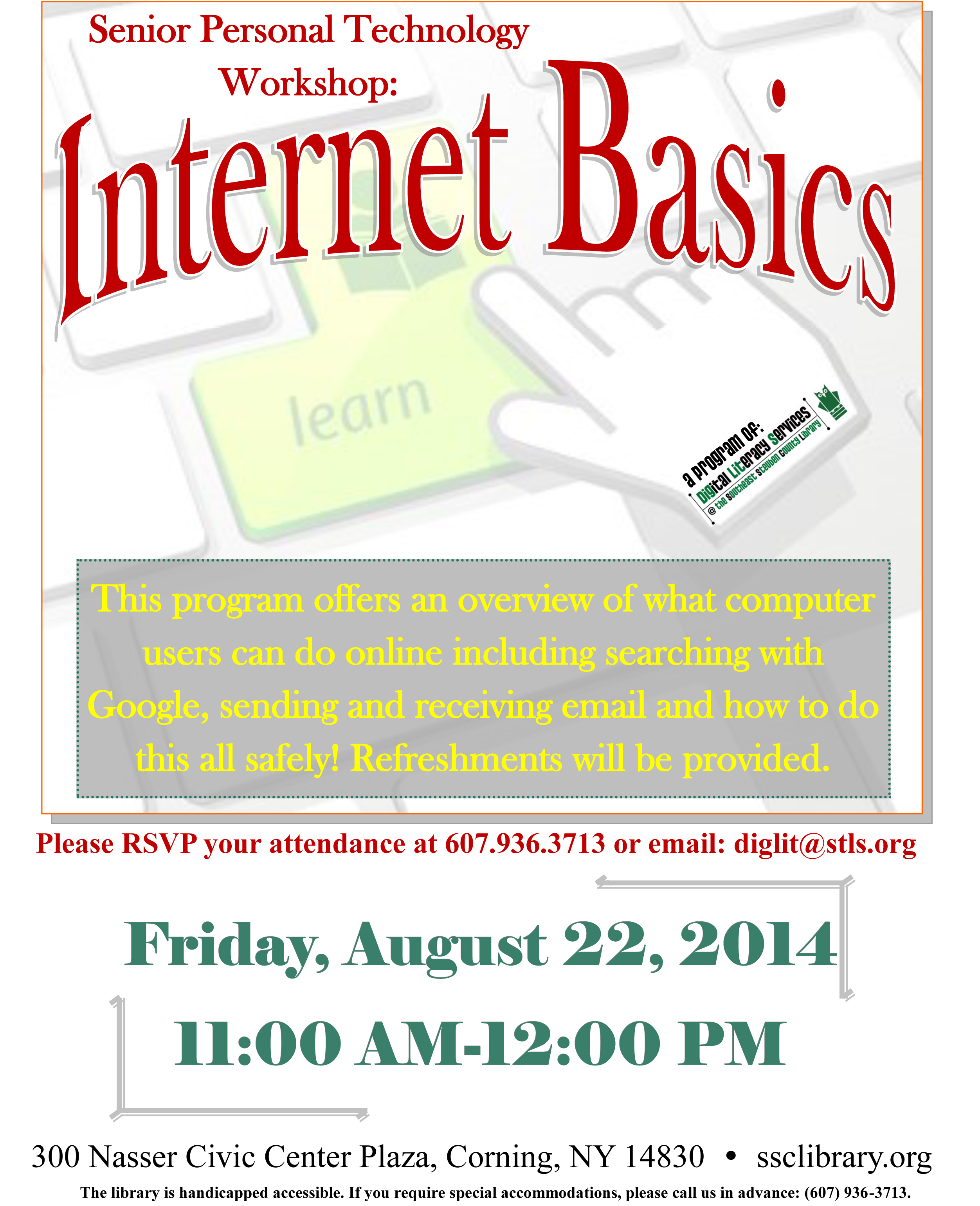
And this Friday, August 22, 2014, we’ll be hosting our monthly Senior Personal Technology program — this one is “Internet Basics” and will offer basic information regarding how you get online and what you do once you get there!
Refreshments will be provided!
Registration is appreciated!
You can register by:
Calling the library at 607-936-3713
Dropping by the library!
Or, sending an email request to: DIGLIT@STLS.ORG
See you on Friday! Linda
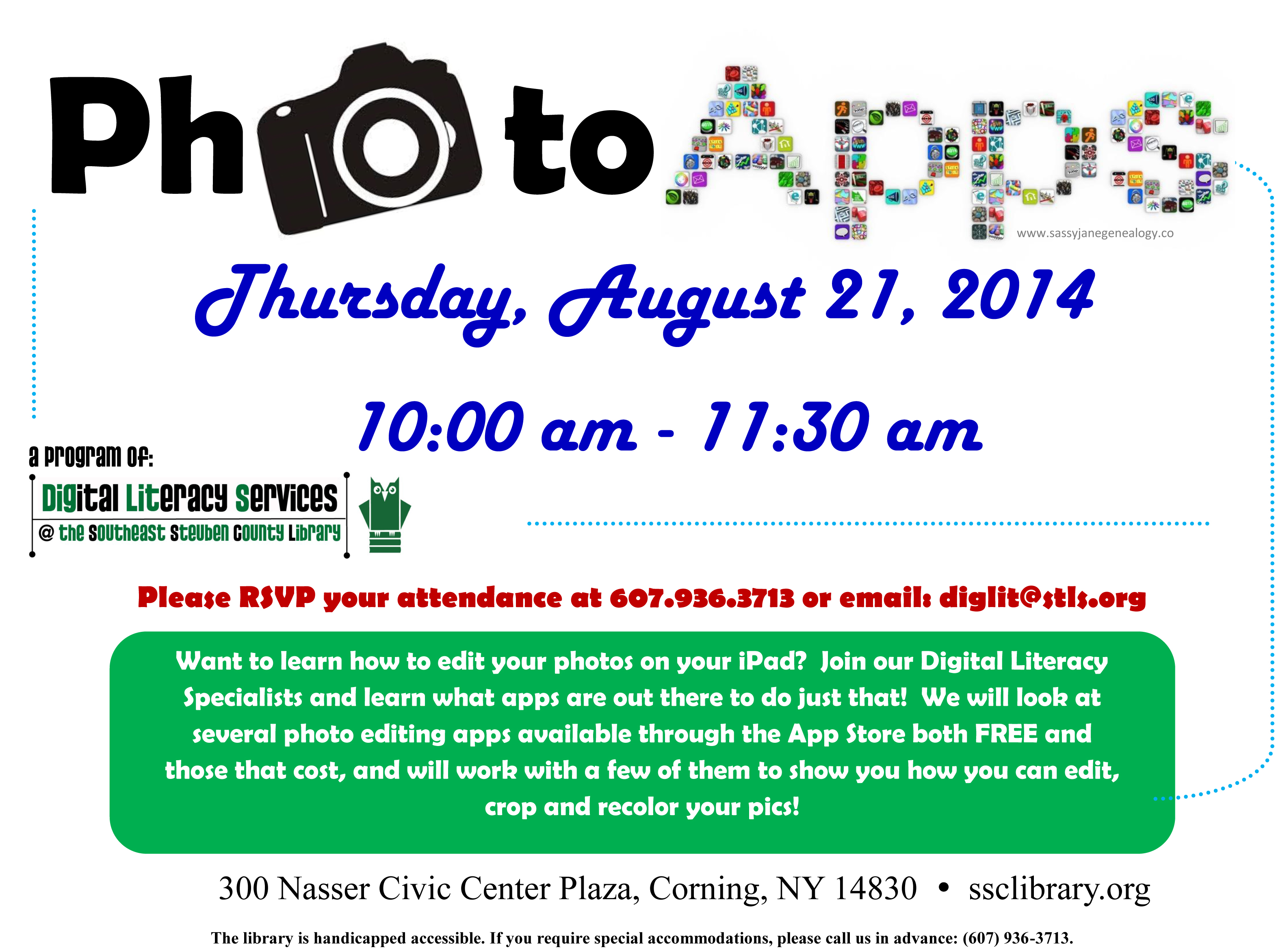
If you have a smartphone or tablet and would like to know more about how to use photo apps, available in your app store, to edit photos or make them fancy, join us for our Photo Apps workshop!
The workshop is free and will be held this Thursday, August 21, 2014 from 10 a.m. to 11:30 a.m.
Registration is appreciated — just so we know how many people to set up for!
You can register in person at the library, by telephone 607-936-3713, or, by sending an email to us at the following email address: DIGLIT@STLS.ORG
Just a reminder for job seekers there is still time to register for the August “Creating An Effective Resume with Lynn Paige” workshop!
The workshop is tomorrow, Wednesday, August 13, 2014, from 1-4 p.m.
And ProAction’s resume and job seeking expert Lynn Paige will be your hostess and with bells on to assist you in creating a brand new, cutting edge resume!
Join us!
Have a great day!
Linda

If you’re looking for a new job or even are just interested in updating your resume – we have workshops for you!
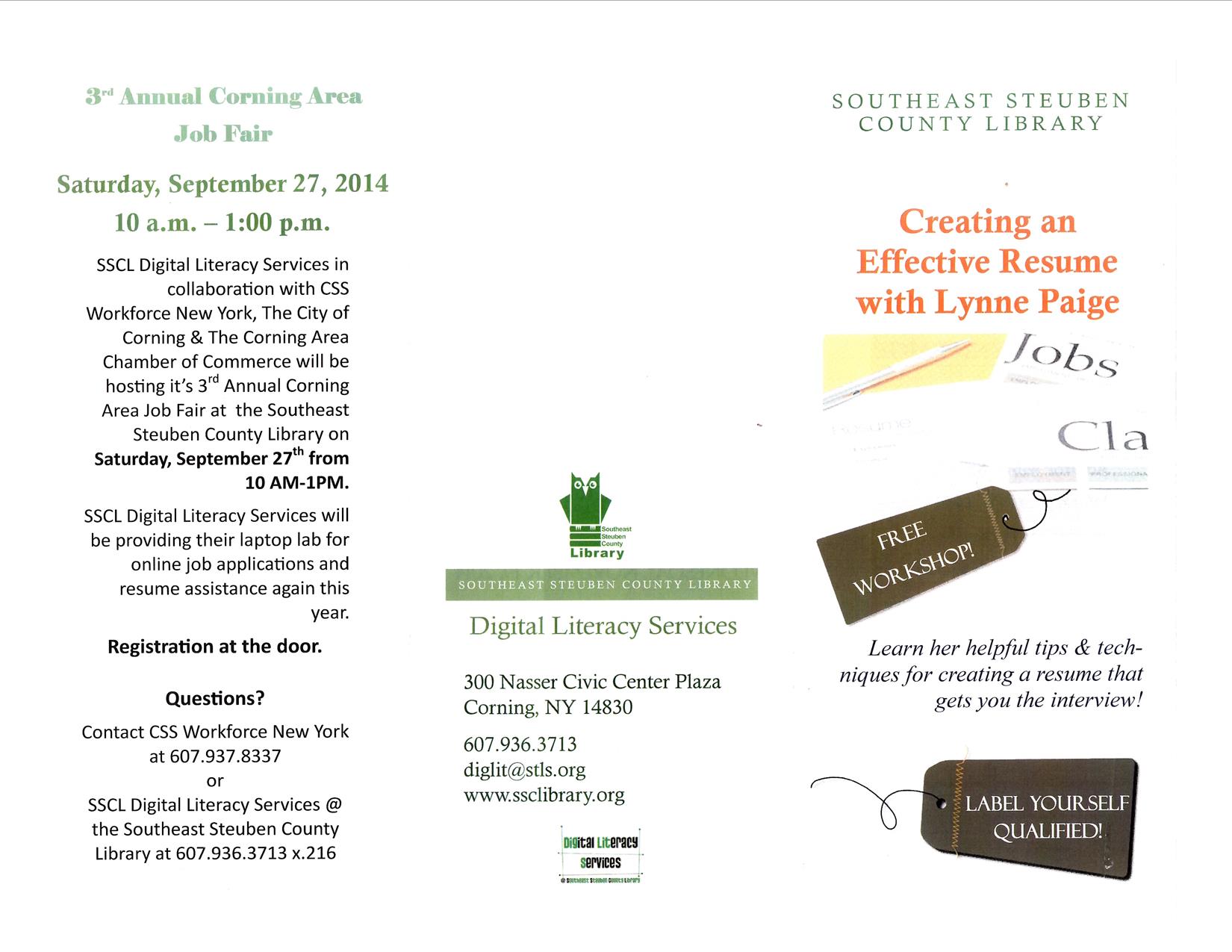
Lynne Paige, a Workforce resume & job search expert who really knows her stuff, is hosting resume workshops at the library in August, September, October & November! And if you attend one of these workshops you’ll leave with a brand resume in hand!
And, on September 27, 2014, SSCL Digital Literacy Services in collaboration with CSS Workforce New York, The City of Corning & The Corning Area Chamber of Commerce will be hosting the 3rd Annual Job Fair at the library!
The Job Fair will run from 10 a.m. to 1 p.m. and we will have staff on hand to assist job seekers in creating a new resume if they don’t already have one!
So join us for our resume workshops, titled Creating an Effective Resume with Lynne Paige, on any of the following dates from 1:00 – 4:00 p.m.:
Wednesday, August 13, 2014
Wednesday, September 10, 2014
Wednesday, October 8, 2014
Wednesday, November 19, 2014.
Resumes workshops are free and you can register for any of the workshops by calling the library at: 607-936-3713; or by sending an email to us at: DIGLIT@STLS.ORG
And just to reiterate, The 3rd Annual Corning Area Job Fair will be held at the library on Saturday, September 27, 2014 from 10:00 a.m. to 1:00 p.m
Join us!
And feel free to print off, email and share the Resume Workshop & Job Fair brochure!
Have a great weekend!
Linda, SSCL Digital Literacy Services

Believe it or not ANSCAR is a real term and not a made up word!
The term ANSCAR is actually, as you probably guessed; an acronym for what is essentially library lingo!
ANSCAR stands for “The Alpha Numeric System for Collections of Recordings.”
And the word is actually pronounced as if it were spelled “answer” — just ignore that “A!”
And if you’re a music fan you should read on because ANSCAR is the system our library uses to file music on CD.
And despite the fact that digital music is exceptionally popular today CDs are still around, we still add them to our collection on a regular basis and they still circulate with furious intensity!
People do love music! (And the library staff does too!)
So if you’re in the library and you love music – you should check out some of our CDs!
The basic gist of the CD classification system is that there are 42 one or two letter prefix codes for the call numbers of music CDs in public library land; and after the prefix code you find the first four letters of the artist, composer or group.
So if you’re looking for the Abbey Road CD by The Beatles you would find that CD is filed thus: MR BEAT AR. Now, there would also be some numbers and letters after the AR so the full ANSCAR code for the Abbey Road CD is this: MR BEAT AR B62.
To break down the ANSCR code for Abbey Road:
The prefix code MR stands for “Rock, Rhythm & Blues.” *1(The entire ANSCAR classification scheme is listed below!)
The next four letters are the first four of the group’s name or the name of the artist – BEAT, of course, stands for Beatles.
The second set of letters in the code – “AR” consists of the first letter in each of the first two words, or three words, of the title – in this case the title only has two words so the “A” is the first letter of Abbey and the “R” is the first letter of Road.
The third set of letters, which is actually just one letter – “B,” is the first letter in the name of the group or the last name of the artist – thus the “B” is the first letter in the name Beatles.*2
And the final two numbers seen right after the “B” – the “62” are the last two numbers of the record company assigned catalog number of the CD. You can find these numbers on the disc itself – and the whole catalog number for this CD version of Abbey Road is: CDP 7 46446 2.
A few more examples of ANSCR classification codes for CDs the library owns are:
Sinatra with Love by Frank Sinatra – MA SINA SWL S 02 (MA stands for Popular Music)
Peaches & Cream: Dances & Marches by John Phillips Sousa – H SOUS PC C05 (H is for brass Band Music)
Birth of Cool by The Miles Davis Quartet – MJ DAVI BOC D27 (MJ stands for Jazz)
Out Among The Stars by Johnny Cash – MC CASH OAS C32 (MC stands for Country & Western Music)
So that is the basic lowdown on how the music compact discs are shelved in our library!
On a related note, if you’re ever looking for a music title you can’t find ask the staff! We’ll either request it from another library if our copy is out or see if we can’t purchase a copy for our collection.
And if you love music – you should also check out the new Freegal Music Service that allows all patrons to download and keep three free songs per week! You can download and keep the songs on a tablet, smartphone or computer.
If you’re using a tablet or smartphone look for the Freegal Music app in your app store.
And if you’re using a PC click on the following link to visit the Freegal Music Services website and log in (with your library card number an PIN)
http://stlsny.freegalmusic.com/
And on another musical note, our Digital Literacy Service staff is going to be hosting a new music program this fall called “Music Old & New & Open Mic Too.”
Our new program will feature tips on how you can use modern technology to enjoy music today as well as a short presentation and will highlight traditional hands on music including: traditional American folk music, blues, country and even a bit of rock n ’roll too.
We’ll feature a discussion section when all attendees will be encouraged to share suggestions as to great songs, artists and albums they enjoy and would recommend to others (and, with the recommenders permission, we will be posting those music suggestions on our blog so we can all access the information later & remember what was suggested!).
We’ll have a staff lead sing-along and close with an open mic session when anyone who wants to sing a song old or new will have the opportunity to do so. The first program is scheduled for Thursday, September 25, 2014 at 6 p.m. Join us!
And that is the library music update for today!
Have a great day!
Linda
SSCL
*1: Here’s the entire ANSCAR Classification Scheme:
A Music Appreciation: History & Commentary
B Operas: Complete & Highlights
C Choral Music
D Vocal Music
E Orchestral Music
EA Orchestral music: General Orchestral
EB Orchestral music: Ballet Music
EC Orchestral music: Concertos
ES Orchestral music: Symphonies
F Chamber Music
G Solo Instrumental Music
GG Solo Instrumental Music: Guitar
GO Solo Instrumental Music: Organ
GP Solo Instrumental Music: Piano
GS Solo Instrumental Music: Stringed Instruments
GV Solo Instrumental Music: Violin
GW Solo Instrumental Music: Wind Instruments
GX Solo Instrumental Music: Percussion Instruments
H Band Music
J Electronic, Mechanical Music
K Musical shows & Operettas
L Soundtrack Music: Motion Pictures & Television
M Popular Music
MA Pop Music
MC Country/Western
MG Contemporary Christian/Gospel
MJ Jazz
ML Latin Pop Music
MN New Age
MR Rock, Rhythm and Blues, etc.
P Folk and Ethnic Music (National)
Q Folk and Ethnic Music (International)
R Holiday Music
S Varieties & Humor
T Plays
U Poetry
Y Sounds & Special Effects
Z Children’s Recordings
ZI Children’s Recordings: Instructional
ZM Children’s Recordings: Music
ZR Children’s Recordings: Holiday
ZS Children’s Recordings: Spoken
*2: For classical recordings the letter in that fourth set of letters/numbers may be the first one in the name of the production company or the title of the piece.
References
ANSCR Classification Summary. Alvin Sherman Library, and Information Technology Center. NOVA Southwestern University. Online. Accessed August 6, 2014, http://www.nova.edu/library/help/misc/anscr.html
The ANSCR Classification System for Sound Recordings. Cal State University Library. Online. Accessed August 6, 2014, http://web.calstatela.edu/library/guides/anscr_class.htm#Examples
 Tech & Book Talk at SSCL